5 Cookieless Analytics for a Small Website Compared
The GDPR has applied since 25 May 2018. On 13 January 2022 the Austrian data protection authority ruled that a website’s use of Google Analytics breached it, because of the transfer of visitor data to the United States; the French CNIL issued a formal notice to the same effect on 10 February 2022. Those two decisions are the origin of most of the tools below. Each one answers the same question: how to count visitors without a cookie, without a stored identifier, and without a consent banner for analytics.

This article compares five tools that a small site can install in an afternoon. Four set no cookie. The fifth, Microsoft Clarity, sets cookies but has a consent mode, and it is the only one of the five that records sessions and heatmaps. Every figure comes from the vendor’s own pricing or documentation page.

1. Plausible
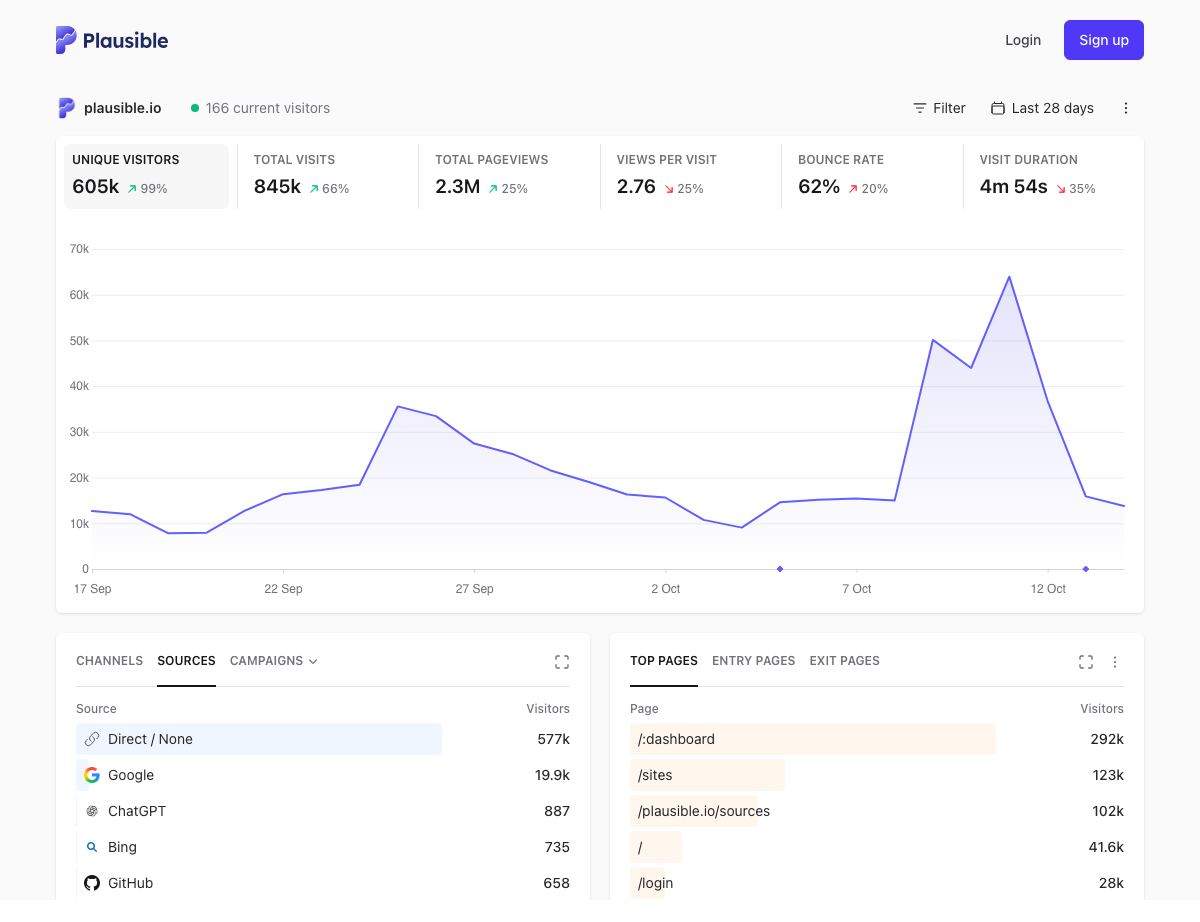
Plausible is an Estonian company; its code is open source and its visitor data stays in the EU. Its data policy says: “We don’t use cookies or generate persistent visitor identifiers.” A visitor is counted for one day through a hash of four inputs, the daily salt, the website domain, the IP address and the user agent, and the salt is deleted every 24 hours.
| Cookies, local storage | None |
|---|---|
| Visitor identity | Daily hash; raw IP and user agent never stored |
| Entry price | $9 a month, 10,000 pageviews, one site; two months free on a yearly plan |
| Free plan | No; 30-day trial, no card |
| Retention | 3 years |
| Self-hosting | Community Edition, AGPLv3, two releases a year, without funnels, revenue goals, SSO and the sites API |
| Script | “54 times smaller than Google Analytics” (vendor) |
| Data location | EU |

2. Fathom
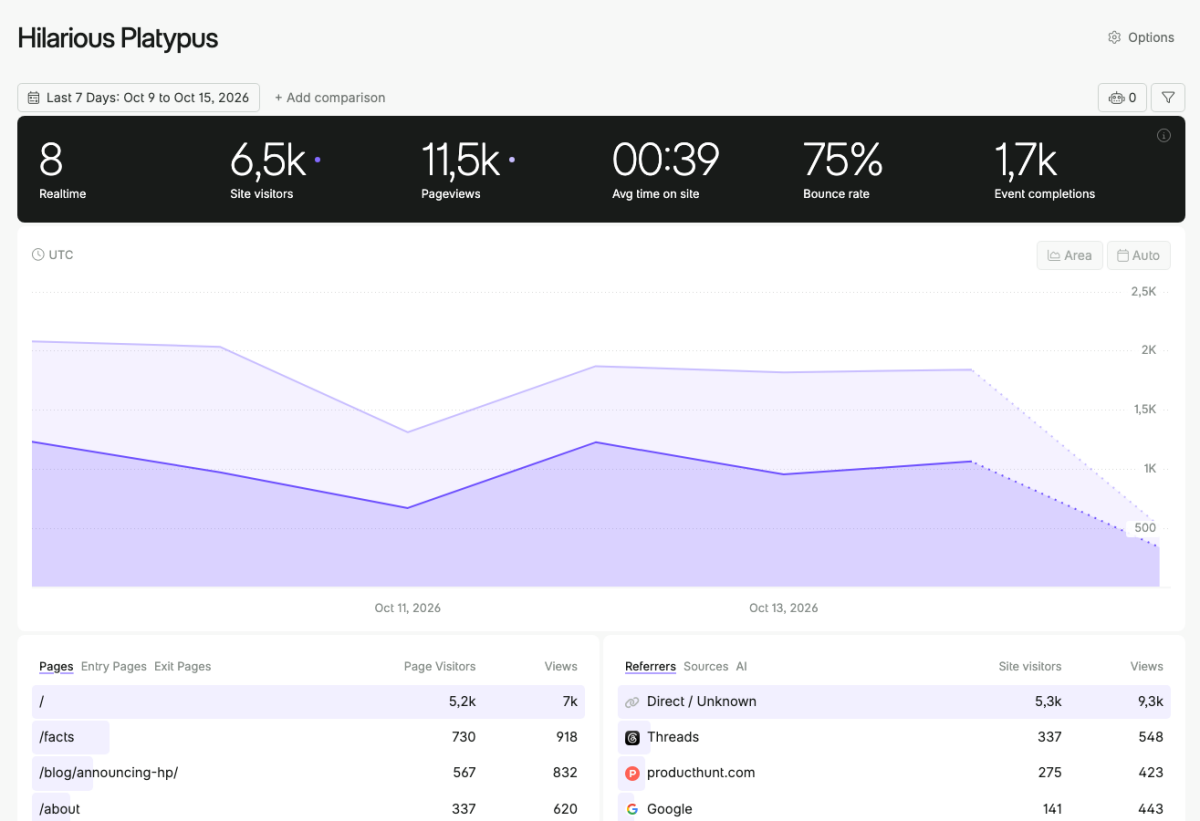
Fathom is a Canadian company. Its headline reads “Analytics without the cookies.” The collector builds a SHA-256 signature from the IP value, the user agent, the site identifier and a daily salt; the salt rotates at midnight UTC. A visitor from the EU is processed on EU infrastructure and anonymized there before anything reaches the United States, a route Fathom calls EU isolation.
| Cookies, local storage | None |
|---|---|
| Visitor identity | Daily SHA-256 signature, salt rotates at midnight UTC |
| Entry price | $15 a month, 100,000 pageviews, 50 sites; extra sites in packs of 50 for $10 a month |
| Free plan | No; 7-day trial, card required |
| Retention | Full history while subscribed |
| Self-hosting | No |
| Compliance stated by vendor | GDPR, CCPA, ePrivacy, PECR |
| Data location | EU route, anonymized before transfer to the US |

3. Umami
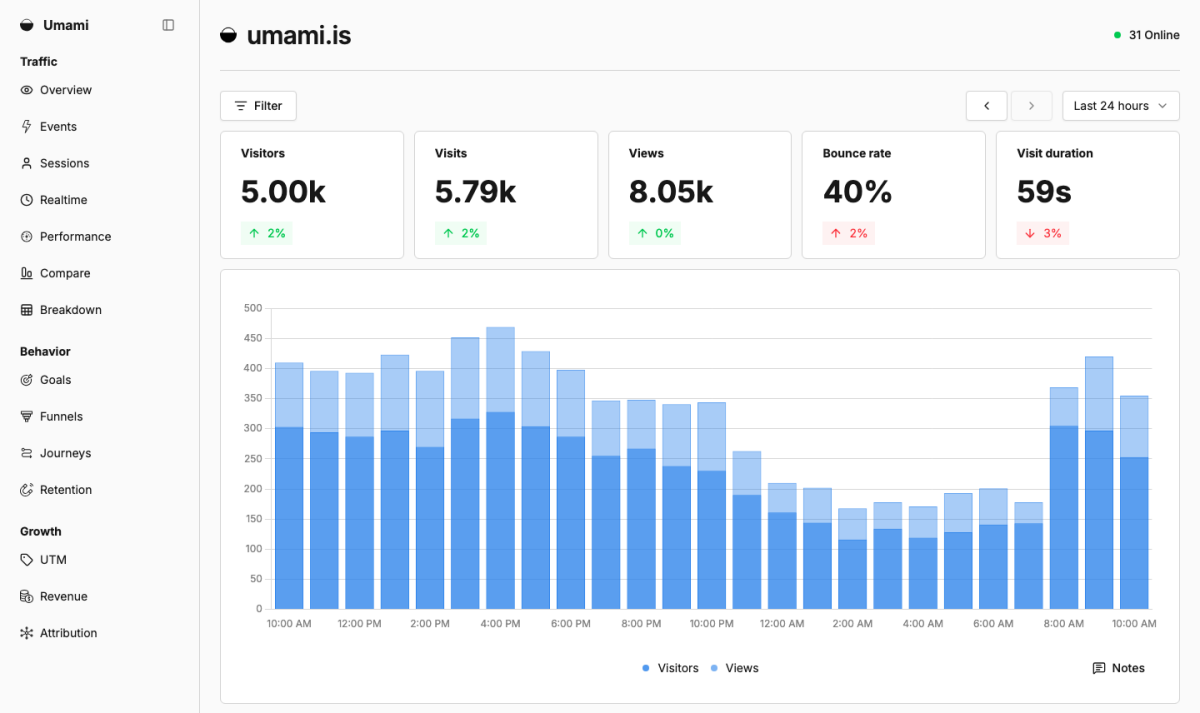
Umami is open source under the MIT license, with 39,000 GitHub stars listed on its site. Its FAQ answers the cookie question in one line: “No, Umami does not use any cookies in the tracking code.” A visitor is an anonymous session identifier; a change of device or browser makes a new visitor. Self-hosting needs Node.js 18.18 or later and PostgreSQL 12.14 or later.
| Cookies, local storage | None |
|---|---|
| Visitor identity | Anonymous session identifier |
| Entry price | Cloud Hobby: free, 100,000 events a month, one website; Pro: $20 a month, one million events, 20 websites |
| Free plan | Yes (Hobby); 14-day trial on paid tiers |
| Retention | 6 months (Hobby), 2 years (Pro), 5 years (Business, $200 a month); indefinite when self-hosted |
| Self-hosting | Yes, MIT |
| Overage | Collection continues past the limit; extra events billed |
| Data location | Umami Cloud, or your own server |
4. Simple Analytics
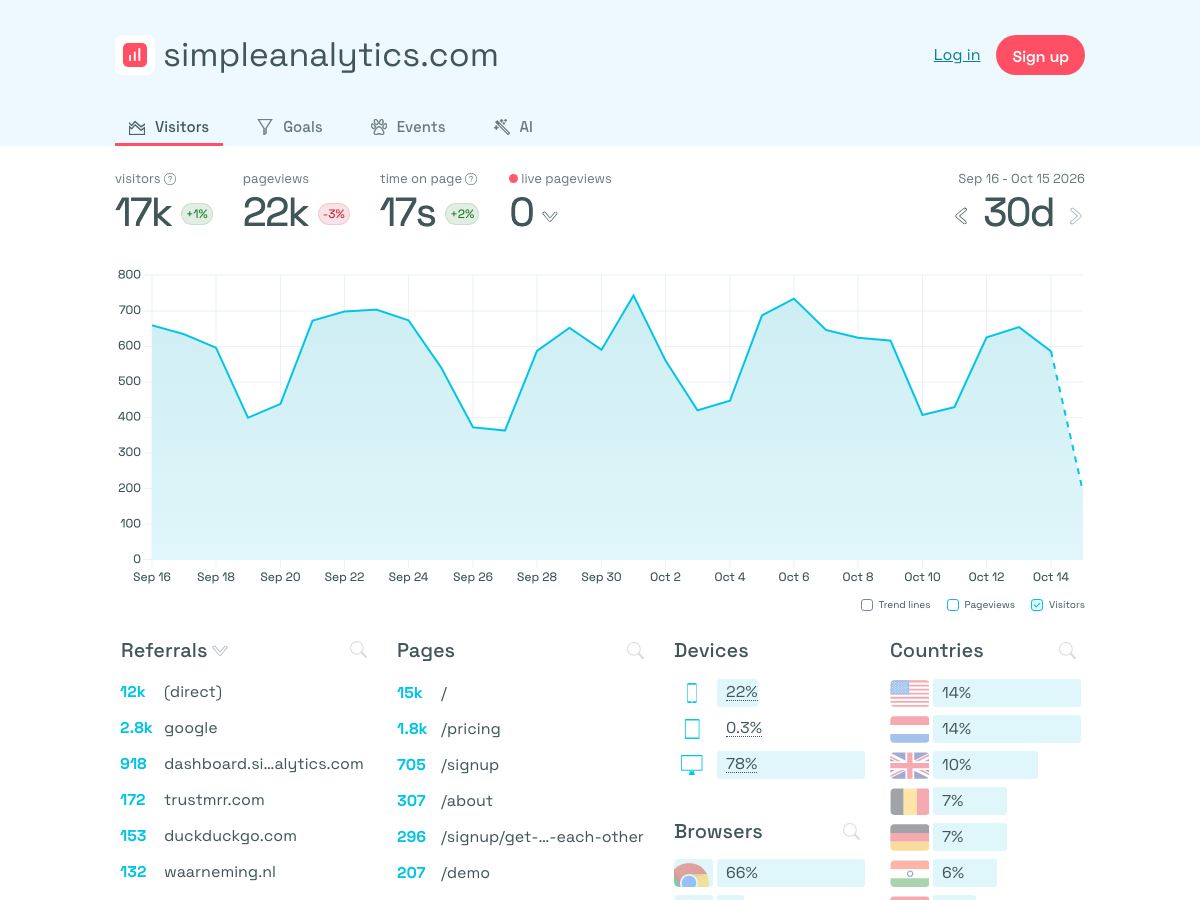
Simple Analytics is a Dutch company with its servers in the Netherlands. Its documentation states: “We drop the IP address from every single request. Period.” Country comes from the visitor’s time zone, not from the IP. A unique visit is detected from the hostname of the referrer: a page view whose referrer is the same domain is a non-unique view. Visits with Do Not Track switched on are left out of the dashboard by default.
| Cookies, local storage, fingerprinting | None |
|---|---|
| Visitor identity | None stored; unique visits by referrer hostname |
| Entry price | Self-serve, 20 euros a month, from 100,000 page views, one user; extra users 20 euros a month each |
| Free plan | Yes, for hobby sites: unlimited page views under fair use, 5 websites, one month of history, a badge on the site |
| Trial | 14 days, no card |
| Retention | 1 month (free); longer on paid plans |
| Self-hosting | No |
| Data location | Netherlands |
5. Microsoft Clarity

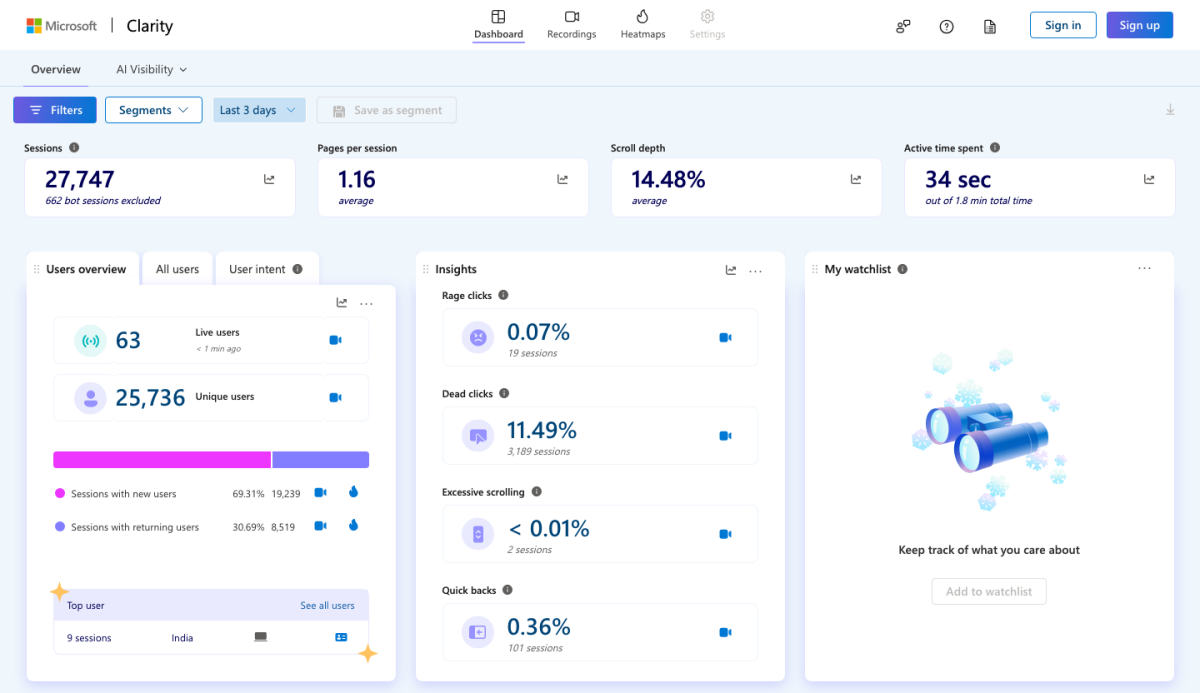
Microsoft Clarity is a behaviour analytics tool: session recordings, heatmaps, insights such as rage clicks and dead clicks, and an AI summary called Copilot. Microsoft’s pricing line is “Free forever. Built to grow with your business. No limits on traffic.” It is the one tool here that sets cookies by default: _clck and _clsk are first-party cookies holding a pseudonymous user ID and a session, and several third-party Microsoft cookies, among them MUID, are set as well.
Consent Mode changes the default. With the cookie setting turned off in the project, Clarity sets no cookie until a consent signal arrives, through a consent management platform or Clarity’s Consent API. Since 31 October 2025 Clarity requires a valid consent signal for visits from the European Economic Area, the United Kingdom and Switzerland, and Consent Mode is on by default for those regions.
| Cookies | Yes by default; none in Consent Mode until consent is given |
|---|---|
| Visitor identity | Pseudonymous ID in the _clck cookie |
| Price | Free, no traffic limits, no sampling |
| Retention | Recordings 30 days; favourites and a random sample up to 9 months; heatmaps 9 months |
| Self-hosting | No |
| Unique to this list | Session recordings, heatmaps |
| Data location | Microsoft |
Side by side
| Plausible | Fathom | Umami | Simple Analytics | Microsoft Clarity | |
|---|---|---|---|---|---|
| Cookies | None | None | None | None | Default yes; Consent Mode available |
| Cheapest paid plan | $9/month | $15/month | $20/month | 20 EUR/month | Free |
| Free plan | No | No | Yes | Yes | Yes |
| Self-hosting | AGPLv3 CE | No | MIT | No | No |
| Session recordings | No | No | No | No | Yes |
What one small site runs

CountIn, a browser tool for musicians that adds a count-in to a backing track, uses two of the approaches above. Microsoft Clarity runs behind a consent gate, with the cookie setting turned off in the project, so recordings exist only for visitors who accepted; it was added on 25 September 2026 for the session recordings. Daily counts of visits, sources, campaigns and languages come from a first-party beacon with no cookies, written for the site and stored as one counter per day per source. The two overlap on nothing: Clarity answers what a visitor did on a page, the beacon answers how many came and from where.
Frequently asked questions (FAQ)
Does a cookieless tool need a consent banner?
Not for the analytics itself, when the tool sets no cookie and stores no persistent identifier, which Plausible, Fathom, Umami and Simple Analytics state in their own documentation. A site may still need a banner for other scripts.
How does a tool count unique visitors without a cookie?
Plausible and Fathom hash the IP address and user agent with a salt that changes every day, so the same person is one visitor within a day and a new one the next. Umami uses an anonymous session identifier. Simple Analytics stores nothing about the person and counts unique visits by the referrer’s hostname.
Which of the five records sessions?
Only Microsoft Clarity. It is also the only one that sets cookies by default, and the only one with a consent mode built for that reason.
Which can be self-hosted?
Umami, under the MIT license, on Node.js and PostgreSQL. Plausible, as the Community Edition under the AGPLv3, released twice a year without the cloud version’s premium features.
What does retention look like on the free options?
Umami Cloud’s Hobby tier keeps six months. Simple Analytics’ free plan keeps one month. Clarity keeps recordings for 30 days and heatmaps for nine months.
About the Author

Paweł Kowalski plays guitar in a cover band and builds CountIn, a browser tool that adds a count-in and a click track to backing tracks for live performance.